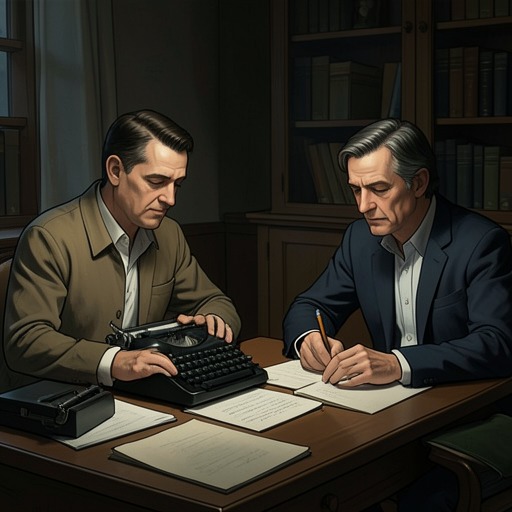
George Stark’s writer’s block
The Dark HalfGeorge Stark’s writer’s block is the weakness that interrupts his self-sufficiency and drives him to demand help from Thad Beaumont. Stark casts the problem as a temporary failure in an imagined creative organ: he needs Thad to restart it, because the writer who has become flesh cannot sustain his existence as a maker without drawing on the writer from whom he came.
The Blockage and Its Trigger
Stark’s difficulty writing becomes urgent once Thad has passed the deadline. Thad has gone to the University expecting Stark to make contact, and Stark intends to reach him there—but not in the way Thad anticipates, or from the place he expects. The deadline therefore converts a creative failure into an active confrontation: Stark needs access to Thad, and the block gives that need its immediate purpose.
The novel links Stark’s difficulty reaching Thad with a small, repeatable physical action. When contact is hard to establish, Stark handles one of the Berol pencils he bought at a Houston Street stationer’s; the gesture helps. It is a practical means of focusing or reaching across their connection, while also returning the problem to writing’s material tools. The pencil does not solve the block, but it helps Stark make contact with the person whose writing he believes can do so.
Stark’s Account of the Cure
At the lake house, Stark tells Alan Pangborn that Thad is going to help him write and that they may work through the night. He expects to have his “house in order” by morning. Liz understands the arrangement as a collaboration on a book, but Stark corrects her: what he wants is not simply instruction in writing. He calls it a “transfusion,” describing his failure as a gland that has temporarily quit and insisting that Thad knows how to make it work again.
Stark explains the dependency through the claim that Thad cloned the relevant creative capacity from himself. In his formulation, Thad built most of Stark’s “equipment”; Stark’s writer’s block is thus not an isolated inconvenience but evidence that the made writer remains reliant on his maker. The bodily metaphor makes the exchange sound less like a lesson than a transfer of substance: Stark does not merely want Thad to show him a technique but to restore something he cannot presently produce on his own.
That account is also bound up with Stark’s sense of literary entitlement. He argues that he taught Thad to write material people would want to read, and that writing matters only if readers want it. The claim turns their creative history into a debt: Stark represents himself as Thad’s teacher and expects repayment in the form of renewed work. His blockage consequently supplies leverage, but it also reveals how much he needs the very person he tries to command.
Creation, Dependence, and Dispute
Stark’s explanation of the block develops into a larger claim about his origin. He says that, once events reached a certain point, he created himself, and suggests that self-creation consumed the energy he now lacks. The extraordinary claim makes the writer’s block part of the cost of Stark’s embodiment: becoming a self, in his telling, has left him unable to keep writing without assistance.
Alan silently rejects the account as incomplete. He understands Stark and Thad as having made each other, not as a creator simply manufacturing an independent creation. Alan’s interpretation reaches back before Thad’s birth and to the intervention of Dr. Pritchard eleven years later; it also recognizes that Thad eventually brought Stark back without knowing what he was doing, because Pritchard had never told him the truth. Stark calls himself the ghost of Thad’s dead brother only in Alan’s inward reckoning, and Alan concludes that the relationship is both more and less than that description. The block therefore sits inside a history of mutual creation that Stark’s self-authored explanation cannot settle.
The exchange leaves the distinction between a temporary creative failure and a deeper dependence deliberately unstable. Stark insists that the problem is only the malfunctioning gland, and presents collaboration as the remedy; Alan’s understanding suggests that the origin of Stark’s existence, rather than an ordinary lapse in productivity, may be crucial to stopping him. Stark wants Thad’s capacity as fuel, while Alan sees their shared origin as a fact with consequences beyond the book they are being forced to write.
Function in the Confrontation
At the lake house, Stark’s promised writing session is inseparable from the danger surrounding the household. He tells Alan that the odds of the sheriff leaving alive are poor, but offers survival as a possibility if the work proceeds. Writing is not a private pursuit in this scene: Stark uses the prospect of a finished book to define what must happen through the night, while Thad’s compelled participation becomes part of the hostage crisis.
The block also exposes a contradiction in Stark’s posture. He speaks as the self-made author who taught Thad and claims a debt, yet his inability to write forces him back toward Thad as a source of creative power. His account makes collaboration sound like a cure, but the circumstances make it coercive. The stalled writer’s demand thus reveals the limits of Stark’s independence: the figure who insists that he created himself cannot simply continue without the human writer whose abilities he claims to have cloned.